

Here is a prompt that generates matching game item icons. Prepper gear, survival loot, fantasy drops, farm sim tools — whatever your niche is buying.
Six lines. One slot to change. Every icon comes out looking like it belongs with the last one.
Grab it and go.
Swap the item description, run it again, and the next icon matches. That is the entire workflow.
The Template
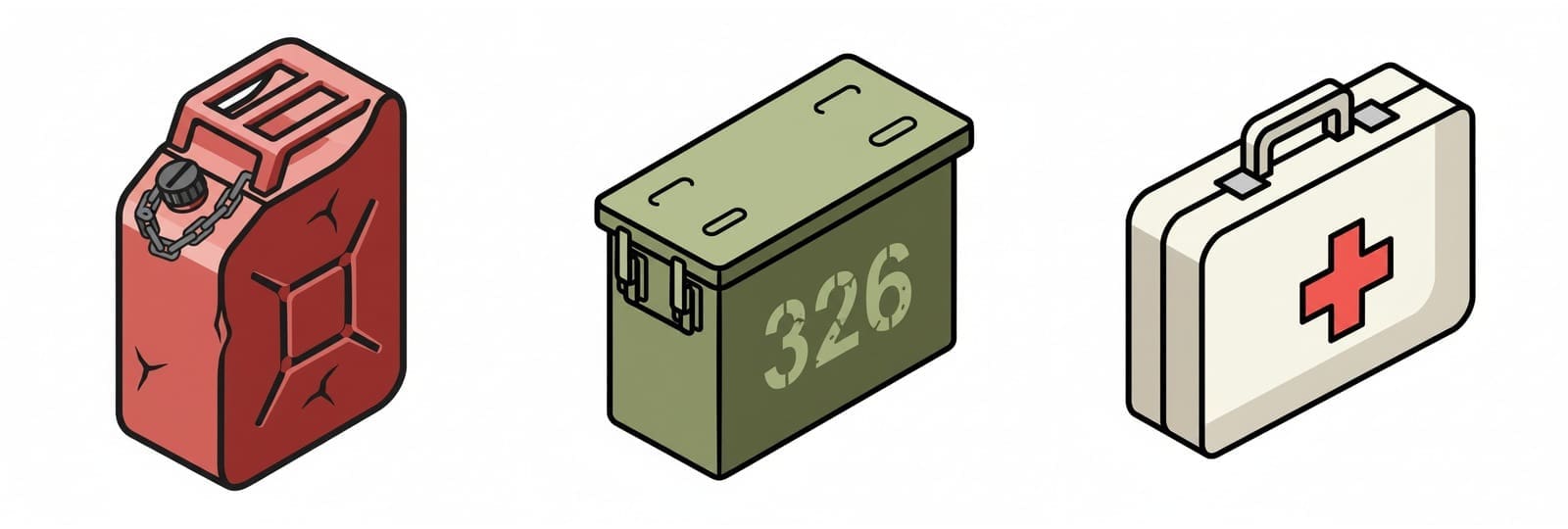
The item line wants three things: what it is, its color, and one specific piece of wear or damage. That last one is the difference between a toy and a game asset — “a green ammo tin” gives you a green box, while “an olive ammo tin with stencilled numbering half worn off” gives you something that looks like it came out of somebody’s inventory screen.

Swap The Whole Genre
The style block does not care what world you are in. Change the items and you have a different product.
Prepper and survival: a dented jerry can, a scuffed ammo tin, a hand-crank radio with a bent antenna, a water filter with a cloudy housing.
Cozy farm sim: a watering can with chipped enamel, a seed packet with a torn corner, a wooden crate of carrots.
Fantasy loot: a dented iron helm, a cracked mana vial, a coin pouch with a loose drawstring.
Sci-fi: a scratched polymer med injector, a battery cell with a scuffed label, a cracked visor.
Keep the last five lines identical every time and each set stays internally consistent, even though the sets look nothing like one another. Which is exactly what you want if you are packaging them up to sell.
Three Lines You Should Not Touch
“Flat 2D vector.” Drop this and “game icon” covers everything from flat vector to a glossy 3D render, so the model quietly picks a different lane on every run. Name the lane and it stops guessing.
“The top, front and one side face all visible.” This is what locks the camera. Asking for a specific angle in degrees works less often than you would hope, because a lot of objects have a pose they want to snap back to — ask a jerry can for a three-quarter view and it will happily hand you a flat front view, because that is how jerry cans get drawn. Demanding three visible faces is checkable, so it holds.
“Top lightest, front mid, side darkest.” My favorite line in the whole thing. Pin the shading to the FACES instead of the object and it cannot drift, because once the pose is locked you already know which faces exist. It also means you can skip a lighting instruction entirely.
Two Things Before You Sell A Pack
The white background is a cutout, not transparency. You still have to key it out afterward if you need a PNG with an alpha channel, and the prompt will not do that part for you.
And it is not one-and-done. I still re-roll roughly one icon in ten, usually because the object came back too small in the frame or the model got lazy and skipped the top face. Cheap to fix, just run it again — but budget for it, because “twelve icons” tends to mean fifteen generations.
Worth saying plainly too: I ran these on Nano Banana, and different models behave differently (and this is constantly evolving tech, so it will probably change by lunch). The three lines above are the ones I would tighten first if yours starts wandering.
Go Make A Set
Pick a genre, write six item lines, run the prompt six times. You will have a matching set in about ten minutes, which is roughly nine hours and fifty minutes faster than learning to draw isometric icons.
If you want something sellable out of the same workflow, The three-step activity page prompt is the closest cousin.