

I’ve read approximately 400 AI blog posts this month (not by choice — research), and I could spot every single one from the first sentence.
They all sound like an enthusiastic marketing intern who just discovered em dashes. You know the type — helpful, polished, completely dead inside.
The problem isn’t the AI. It’s that nobody showed it what “good” looks like before asking it to write.

The Voice Problem Nobody Talks About
What usually happens: you open ChatGPT (or Claude, or whatever your poison is), type something like “write a blog post about AI prompting in a casual, authentic tone,” and hit enter.
What comes back isn’t wrong — grammatically correct, reasonably structured, perfectly readable and following your overall prompt. It also reads like every other piece of trash AI content on the internet.
You asked for “casual and authentic.” But those words mean very little to an AI model. It doesn’t know what YOUR casual sounds like. It knows what the average internet’s “casual” sounds like — which is the most un-casual thing imaginable. Internet peeps are anything but normal casual when hiding behind a keyboard.
It’s like telling a chef “make it taste good.” Okay… good how? Spicy good? Smoky good? Your grandma’s cooking at Thanksgiving good? Without a reference point, you get the statistical average of all “good” food, which likely doesn’t taste anything like your version of good.
The Fix: Two Simple Examples.
Instead of describing your tone with adjectives, show the AI two short examples of your actual writing. Then ask it to match.
That’s the whole technique. No 47-step framework. No premium prompt template. Just: here’s what I sound like, now write like that. I have two articles (which is overkill) I reference that I wrote from start to finish that I like to use as they really capture my style (which tends to be a conversational tone, for what it’s worth).
The Test For Your Review.
I ran the same task through the same model twice. Same topic and length, identical request.
The only difference: one prompt said “use a casual, authentic tone.” The other included two short excerpts of real writing and said “match this voice.”
Prompt A (Generic):
“Write a short blog intro about why most AI content sounds the same. Use a casual, authentic, conversational tone.”
Output A:
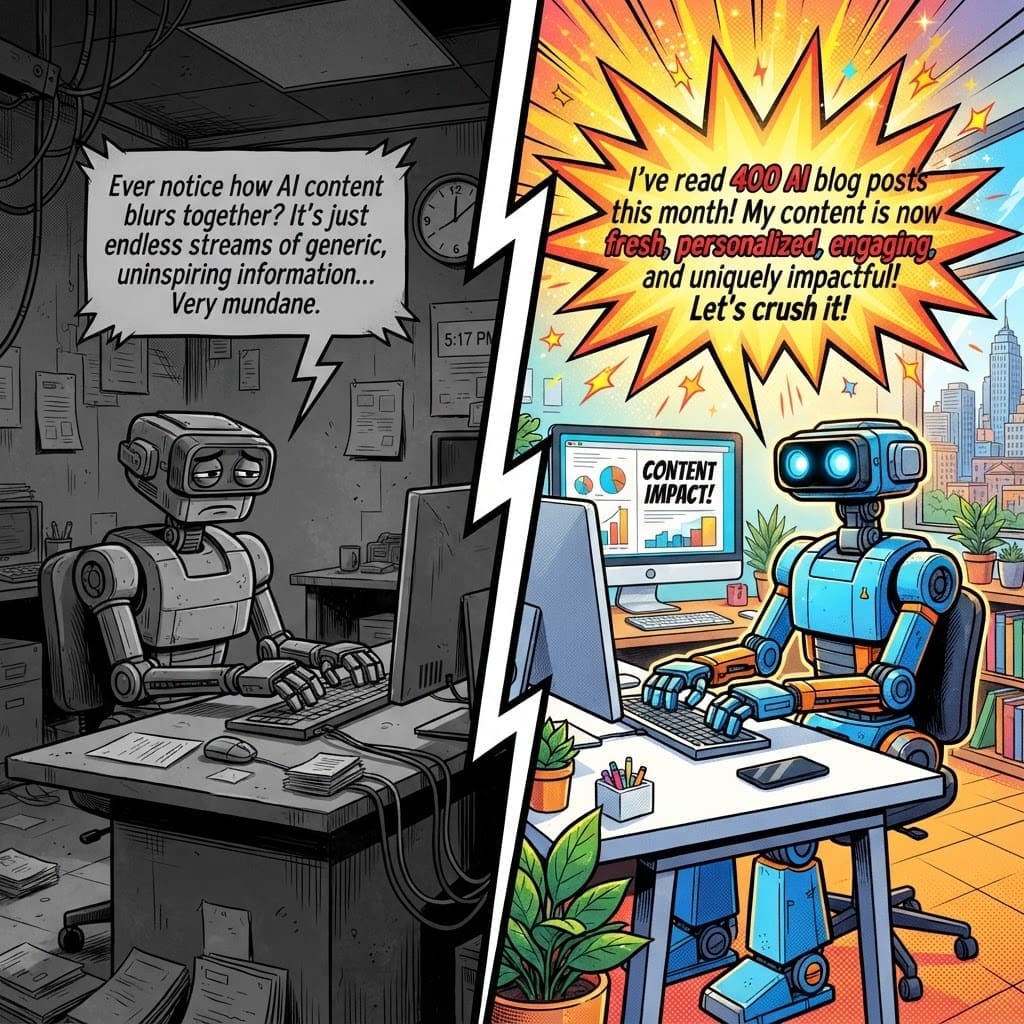
“Ever notice how AI-generated content all seems to blur together? Whether it’s a blog post, email, or social media caption, there’s a certain something that makes it instantly recognizable as machine-written. The good news? With a few simple tweaks, you can break free from the generic AI voice and create content that actually sounds like you.”
Pleasant and competent, sure. Also completely forgettable — I’ve read that paragraph a thousand times and couldn’t tell you who wrote it.
Prompt B (Voice-Calibrated):
Same request — but with two short examples of real writing included, plus a brief note about what to match:
“Write a short blog intro about why most AI content sounds the same. Here are two examples of the voice I want you to match:”
[Example 1: A paragraph about being single dad for a week, with parenthetical asides and self-deprecating humor]
[Example 2: A paragraph about buying too much PLR content, with casual confession and specific details]
Output B:
“I’ve read approximately 400 AI blog posts this month (not by choice — research), and I could spot every single one from the first sentence. They all sound like a really enthusiastic marketing intern who just discovered em dashes. You know the type — helpful, polished, completely dead inside. The problem isn’t the AI. It’s that nobody showed it what ‘good’ looks like before asking it to write.” (Look familiar :))
The Difference
Output A is the paragraph version of elevator music. It’s not wrong. It’s just nothing.
Output B has personality — parenthetical asides, a specific (slightly exaggerated) number, a dry metaphor that actually lands. It builds to a real conclusion instead of trailing off into “the good news?”
Same model. Same setup. The only difference was two examples and a one-line instruction. That’s not to say it’s perfect, but it’s much closer.
How To Use This (Copy-Paste Template)
The exact structure I use. Replace the bracketed parts with your own content.
[Your task — what you want the AI to write]
Here are two examples of the voice I want you to match:
Example 1: [Paste 3-5 sentences of your real writing — ideally something with personality, not a boring work email]
Example 2: [Paste another 3-5 sentences — different topic, same voice. The variety helps the model find the pattern instead of copying the content]
Match this voice. Do not use the exact content from the examples — match the tone, rhythm, and style.
Why Two Examples and Not One (or Five)
One example and the AI tends to copy it too closely. It picks up the content instead of the pattern.
Five examples and you’re just burning context window for no reason. Two is the sweet spot. The model sees two different pieces of writing with the same voice and starts to extract what stays consistent across both — instead of mimicking the topic.
Think of it like training a new hire. You don’t hand them a 200-page manual (that’s five examples). And you don’t show them one email and say “do this” (that’s one example). You show them a couple of things you wrote and say “get the vibe.”
What To Pick For Your Examples
Not all writing works equally well for calibration. What to look for:
- Pick writing with personality. A casual email to a friend beats a LinkedIn post. You want the AI to hear your real voice, not your “professional” voice.
- Pick different topics. Two examples about the same thing teach the model the topic, not the voice. Different topics force it to find the underlying pattern.
- Pick short examples. 3-5 sentences each. Long enough to show rhythm, short enough that you’re not eating your context window.
- Pick writing you actually like. Sounds obvious, but if you pick something you’re not proud of, the AI will faithfully reproduce writing you’re not proud of.
Quick note here. My preferred method is to actually train a specialized agent with long term memory and parameters with this and much more trained into it. This is where the real savings and time come it, but I write these articles with the intent of helping out those who are using one off flows (often with free tools). If you want a custom agent, but need help…hit me up and we can talk about a specialty build for you. Or, keep following here. Over time I’ll share all those secrets as well.
The Bottom Line
A lot of AI content sounds the same because a lot of people give the AI the same input: vague adjectives and no reference point.
It’s not about a better model or a longer prompt. It’s about showing the AI what “good” looks like — your version, not the internet’s average.
Two examples. One instruction. That’s the whole thing.
Try it on your next piece of content. Paste two things you wrote that you’re actually proud of. Ask the AI to match. See if the difference doesn’t smack you in the face.
And if it doesn’t work — pick better examples. The technique is solid. The input is what matters.
The 5-minute prompt formula is the faster version of this, and the AI sandwich is where the calibrated draft goes next.